The Real Cost of Nurse Turnover: Why Scheduling Is Your Most Overlooked Retention Strategy

Nurse retention is one of the most significant controllable costs in any healthcare organisation. Yet most hospitals are managing it with the wrong set of tools.
Healthcare leaders track overtime. They track agency spend. They track vacancy rates. What most don't track is the full financial cost of nurse turnover - and the extent to which the scheduling environment is driving it.
The omission is expensive.
Key takeaways
- Replacing a single nurse costs between 75% and 200% of annual salary - up to $180,000 per exit
- Scheduling quality is consistently ranked among the top drivers of nurse turnover
- Self-rostering has reduced turnover to near-zero in peer-reviewed implementations
- Flexible work schedules independently increase nurse job satisfaction odds by 16% (Duffield et al., 2010)
- The payback period on scheduling investment is short relative to the turnover it prevents
What Nurse Turnover Actually Costs
The commonly cited range for replacing a single nurse is between 75% and 200% of annual salary. For an experienced nurse earning $90,000, that means a replacement cost of $67,500 to $180,000 per exit.
That figure bundles several components that rarely appear on a single budget line:
- Direct recruitment costs: advertising, agency fees, background checks, hiring manager time
- Onboarding and training: orientation, preceptorship, and learning-curve productivity loss
- Temporary coverage: agency or locum staff during the vacancy, typically at premium rates
- Institutional knowledge loss: experienced nurses carry knowledge about patients, teams, and processes that doesn't transfer on a spreadsheet
- Downstream turnover: increased workload on remaining staff raises burnout, which raises further turnover
The AHA's 2024 Costs of Caring report found that labour expenses have become the single largest financial pressure on hospitals, driven in part by agency and travel nurse reliance. The same dynamic appears across Australia and New Zealand, where striking nurses have cited agency staff spend as evidence that the system has money for care - just not to retain the people delivering it.
Why Scheduling Is a Nurse Retention Strategy
Scheduling is consistently listed among the top reasons nurses leave their current role. This isn't anecdotal - it's documented across peer-reviewed research in multiple countries.
A large Australian study of 2,488 nurses across 94 wards in 21 public hospitals found that flexible or modified work schedules independently increased the odds of job satisfaction by 16%, and that nurses who participated in developing their own working schedules reported significantly higher satisfaction overall (Duffield et al., 2010). The same study identified five leadership characteristics that most distinguished high-retention wards from low-retention wards - and flexible scheduling was one of them.
A Swiss cross-sectional study of 1,833 registered nurses found that higher schedule flexibility was independently associated with lower emotional exhaustion (β −0.11), and that 32% of nurses reported little or no influence on planning their own shifts - a directly addressable organisational gap (Schubert et al., 2018).
In a peer-reviewed NZ radiology study, 35% of staff had considered changing jobs due to rostering constraints in the prior year - more than a third of a working clinical department (You Make the Call, Radiography, 2024).
Research by Bae (2023) established a direct statistical relationship between weekly working hours and nurse turnover: more overtime hours predict higher exit rates. Every overtime hour is not just a penalty-rate labour cost in the current pay period - it is an investment in future turnover (Bae, 2023).
A multicountry study found that nurses working 12+ hour shifts reported significantly higher intention to leave (Dall'Ora et al., 2015). Shift length, recovery time, and schedule predictability are scheduling design variables - and they all affect the probability that a nurse will still be on your roster in 12 months.
The Financial Case for Scheduling Investment
Against the full cost of nurse turnover, scheduling technology looks like a different investment entirely.
The Norfolk and Norwich self-rostering implementation recorded near-zero turnover in the year following rollout, compared to 2–5% monthly turnover on standard-rostered wards in the same institution (Norfolk & Norwich NHS, 2021). Ward vacancies dropped from 5 FTE to zero. A waiting list of nurses wanting to join the team formed. Roster completion time fell from 4 hours to 47 minutes.
A hospital ward running at 2% monthly turnover (24% annually on a 46-person team) might expect to replace 11 nurses per year. At a conservative replacement cost of $75,000 per nurse, that's $825,000 per ward per year in turnover costs. The same ward, after self-rostering, replaced 2 nurses.
A simple illustration of the ROI:
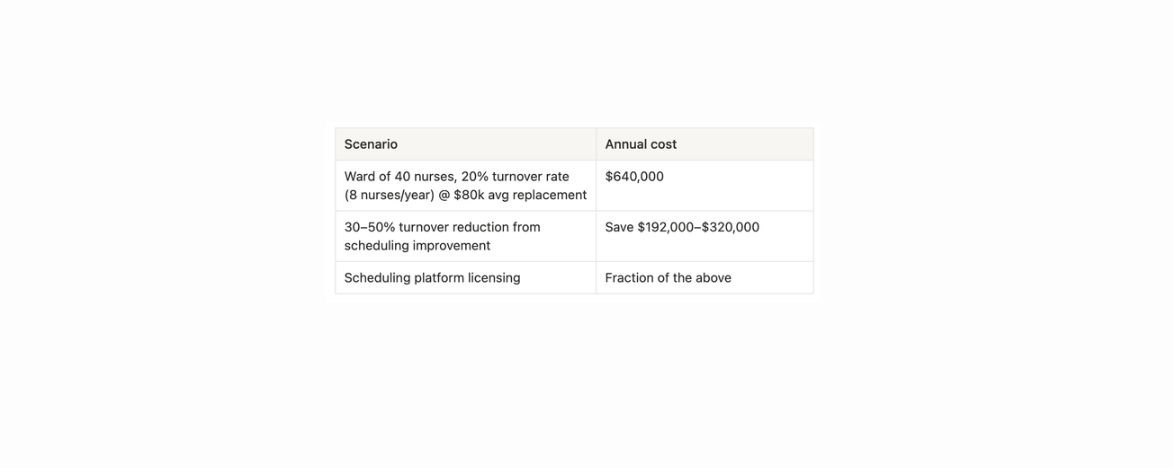
The Griffiths et al. review (2023) confirmed the cost-effectiveness argument from a different angle: improved staffing and skill mix reduces adverse events, shortened stays, and readmissions - costs that remain invisible when leaders look only at labour line items (Griffiths et al., 2023).
Nurse Retention Strategies That Start With the Roster
Most nurse retention strategies focus on culture, pay, or career development. These matter. But they sit downstream of a more fundamental variable: whether nurses have predictability, fairness, and some degree of control over their working lives.
The research evidence points to three scheduling levers with documented retention impact:
1. Schedule flexibility and input
Nurses who participate in developing their own schedules report higher satisfaction and lower intention to leave. This doesn't require full self-rostering - even structured preference submission processes reduce the experience of arbitrary allocation.
2. Reasonable shift lengths and recovery time
Nurses working 12+ hour shifts consistently report higher burnout and turnover intention. The scheduling design decision to limit excessive consecutive hours is, at population scale, a retention intervention.
3. Predictability and advance notice
Late-notice changes and last-minute shift calls are among the top complaints from nurses considering leaving. Schedule stability is a direct input to workforce stability.
The Conversation CFOs Are Not Having
Most healthcare CFOs are running three separate conversations: one about agency spend, one about overtime premiums, and one about recruitment budgets. They are not connecting those costs to the scheduling environment generating them.
The research evidence is unambiguous:
- Scheduling quality directly affects how long nurses stay
- Nurse turnover is one of the largest controllable labour costs in healthcare
- Scheduling improvement is a cost-effective, evidence-backed intervention against both
The business case is not that scheduling technology is free. It's that it is cheap relative to what it prevents. And what it prevents, at full cost accounting, is one of the most significant and underacknowledged financial drains in any healthcare organisation.
If your hospital is running chronic overtime, high agency spend, and persistent vacancy rates, the root cause analysis should not stop at headcount. It should include a hard look at whether the scheduling system is contributing to the problem - and what it would cost, against the full turnover figure, to fix it.
You might also be interested in


Ready to Transform Your Workforce Management?
Join thousands using RosterLab to streamline rostering.